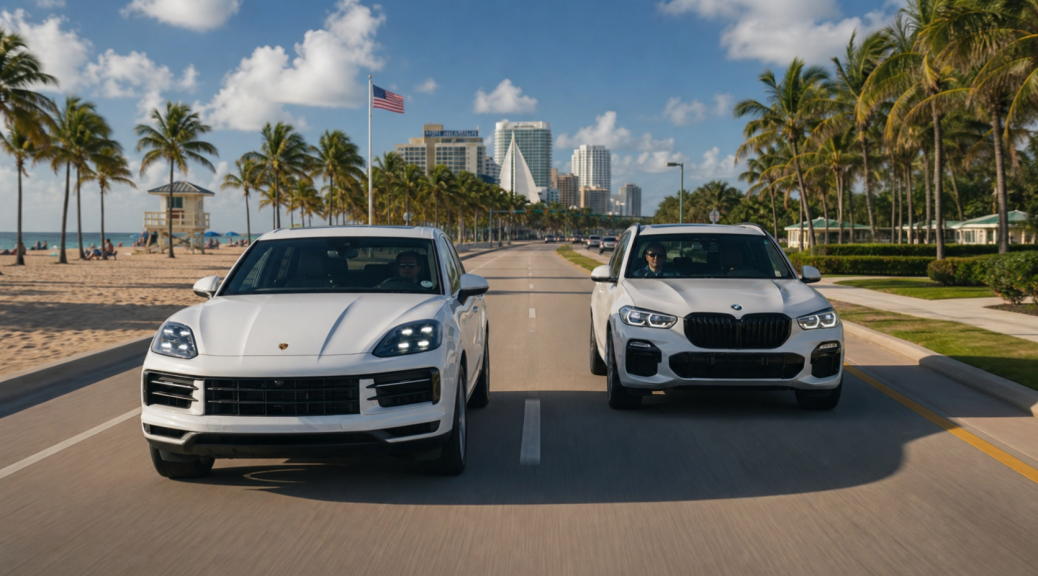
Two luxury SUVs enter. Only one carries the sports-car DNA that transforms your daily commute into something worth anticipating.
The Core Question
When you spend $70,000–$160,000 on a luxury SUV, you are not merely buying transportation. You are buying an experience—how the steering weights up through a corner, how the chassis settles over broken pavement, how the engine responds when you ask for more. The 2026 Porsche Cayenne and 2026 BMW X5 both occupy this rarified space, but they answer the same question with fundamentally different philosophies.
The BMW X5 asks: “What if a luxury sedan grew taller?”
The Porsche Cayenne asks: “What if a 911 had room for your family?”
For drivers in Pompano Beach, Fort Lauderdale, and Miami—where highway merges demand authority and coastal roads reward precision—this distinction matters. This guide breaks down every measurable difference, from horsepower to cargo space to long-term ownership costs, so you can choose with confidence.
2026 Porsche Cayenne vs. 2026 BMW X5: At a Glance
| Specification | 2026 Porsche Cayenne Base | 2026 BMW X5 xDrive40i |
|---|---|---|
| Starting MSRP | $86,800 | $72,050 |
| Engine | 3.0L turbo V6 | 3.0L turbo I6 mild hybrid |
| Horsepower | 348 hp @ 5,400 rpm | 375 hp @ 5,200 rpm |
| Torque | 368 lb-ft @ 1,450 rpm | 398 lb-ft @ 1,850 rpm |
| Transmission | 8-speed Tiptronic S | 8-speed automatic |
| 0–60 mph | 5.7 seconds | 5.2 seconds |
| Top Speed | 154 mph | 130 mph (limited) |
| Towing Capacity | 7,716 lbs | 7,200 lbs |
| Cargo Space (seats up) | 27.3 cu.ft. | 33.9 cu.ft. |
| Cargo Space (seats down) | 60.3 cu.ft. | 72.3 cu.ft. |
| Curb Weight | 4,678 lbs | 4,998 lbs |
| Fuel Economy (combined) | 19 MPG | 25 MPG |
| Standard Drivetrain | AWD | AWD (xDrive40i) |
| Reliability Score (JD Power) | 84/100 | 81/100 |
Powertrain Comparison: Where the Philosophies Diverge
The BMW X5 Approach: Technological Breadth
BMW offers four distinct powertrains for 2026, each optimized for a different use case:
| Trim | Engine | Horsepower | Torque | 0–60 mph | MSRP |
|---|---|---|---|---|---|
| sDrive40i | 3.0L turbo I6 | 375 hp | 398 lb-ft | 5.3 sec | $69,750 |
| xDrive40i | 3.0L turbo I6 + mild hybrid | 375 hp | 398 lb-ft | 5.2 sec | $72,050 |
| xDrive50e | 3.0L turbo I6 PHEV | 483 hp | 516 lb-ft | 4.6 sec | $77,450 |
| M60i | 4.4L twin-turbo V8 | 523 hp | 553 lb-ft | 4.2 sec | $95,050 |
The xDrive50e plug-in hybrid is BMW’s standout offering. With 483 hp, 516 lb-ft of torque, and an estimated 40 miles of electric-only range , it delivers the efficiency of a commuter car with the acceleration of a sports sedan. The M60i’s 4.4L V8—shared with BMW M division vehicles—provides effortless passing power and a soundtrack that justifies the $95,000 entry fee.
However, BMW’s approach has trade-offs. The mild-hybrid system on the 40i adds complexity without delivering the efficiency gains of a full hybrid. The PHEV’s 5573-lb curb weight dulls handling response compared to the gas-only models. And across the lineup, the X5 prioritizes isolation over engagement—the steering filters out road texture, the suspension absorbs bumps rather than communicating them, and the transmission shifts for smoothness rather than immediacy.
The Porsche Cayenne Approach: Sports-Car DNA in SUV Form
Porsche offers six trims for 2026, each representing a different expression of the same chassis philosophy:
| Trim | Engine | Horsepower | Torque | 0–60 mph | MSRP |
|---|---|---|---|---|---|
| Cayenne | 3.0L turbo V6 | 348 hp | 368 lb-ft | 5.7 sec | $86,800 |
| Cayenne E-Hybrid | 3.0L V6 + electric motor | 463 hp | 479 lb-ft | 4.6 sec | $101,150 |
| Cayenne S | 4.0L twin-turbo V8 | 468 hp | 442 lb-ft | 4.7 sec | $105,950 |
| Cayenne S E-Hybrid | 3.0L V6 + electric motor | 512 hp | 553 lb-ft | 4.4 sec | $109,150 |
| Cayenne GTS | 4.0L twin-turbo V8 | 493 hp | 486 lb-ft | 4.4 sec | $129,250 |
| Cayenne Turbo E-Hybrid | 4.0L V8 + electric motor | 729 hp | 700 lb-ft | 3.5 sec | $161,050 |
Even the base Cayenne’s 348-hp V6—down 27 hp compared to the BMW xDrive40i—delivers a more engaging driving experience. The 8-speed Tiptronic S transmission, developed in-house by Porsche, holds gears to redline in Sport Plus mode and executes downshifts with a rev-matching precision that BMW’s ZF automatic cannot replicate. The steering, standard with Porsche’s variable-ratio rack, weights up organically as cornering forces build. And the PASM (Porsche Active Suspension Management) system—standard on every Cayenne—adjusts damping force at each corner individually, 200 times per second .
Where Porsche truly separates itself is at the extremes. The Cayenne Turbo E-Hybrid’s 729 hp and 700 lb-ft of torque make it the most powerful production SUV Porsche has ever built. Its 3.5-second 0–60 time and 183-mph top speed place it in supercar territory. The BMW X5 M Competition, by comparison, produces 617 hp and tops out at 177 mph—impressive, but not class-leading.
For South Florida buyers, the Cayenne’s performance envelope has practical implications. The ability to accelerate from 80–120 mph in under 4 seconds makes highway passing effortless on I-95. The 7,716-lb towing capacity —516 lbs more than the X5’s 7,200 lbs —handles boat trailers to the Keys without strain. And the available Porsche Dynamic Chassis Control (PDCC) and rear-axle steering shrink the Cayenne’s turning circle to 39.7 feet , tighter than many compact sedans.
Chassis and Handling: The Decisive Difference
Porsche Cayenne: Track-Proven Engineering
The Cayenne’s chassis architecture traces its lineage to the Volkswagen Group MLB Evo platform, shared with the Audi Q7 and Bentley Bentayga, but Porsche’s engineering team modifies every component. The front suspension uses double wishbones rather than the MacPherson struts common in this segment, providing more precise camber control during hard cornering. The rear suspension is a multi-link design with aluminum control arms to reduce unsprung weight.
Standard PASM adjusts damping force across three modes: Normal, Sport, and Sport Plus. The optional adaptive air suspension—highly recommended for South Florida’s variable road surfaces—varies ride height by up to 2.4 inches, lowering the Cayenne for highway stability and raising it for flood-prone areas or light off-roading.
The available PDCC system uses active anti-roll bars to counteract body lean during cornering. In practice, this transforms the Cayenne from “surprisingly agile for an SUV” to “genuinely fast on a back road.” Motor Trend’s testing recorded 0.92 g of lateral grip for the Cayenne GTS on street tires—a figure that embarrasses many sports cars .
BMW X5: Comfort-First Tuning
The X5’s chassis—built on BMW’s CLAR platform—prioritizes ride quality over cornering precision. The standard suspension uses steel springs with adaptive dampers; air suspension is optional on the 40i and standard on the M60i. The steering, while accurate, filters out road texture in the name of refinement.
The X5’s dynamic limits are respectable for the segment. Car and Driver recorded 0.87 g of lateral grip for the xDrive40i—solid, but not exceptional. The M60i, with its active anti-roll bars and rear-axle steering, narrows the gap to the Cayenne S, but it cannot match the Porsche’s fundamental balance.
For daily driving in South Florida traffic, the X5’s softer tuning has merit. Potholes on US-1 disappear beneath the wheels. Highway cruising at 80 mph requires minimal correction. But when the road opens up—on the Sawgrass Expressway at dawn, or A1A through Fort Lauderdale—the X5’s limits arrive sooner, and they announce themselves with understeer and tire squeal rather than the Cayenne’s neutral, adjustable balance.
Interior Quality and Technology
BMW X5: The Tech Leader
BMW’s iDrive 8.5 system, standard across the X5 lineup, features a 14.9-inch curved touchscreen integrated with a 12.3-inch digital instrument cluster. The interface is visually stunning, with configurable widgets, augmented reality navigation, and natural-language voice control. The available Bowers & Wilkins Diamond Surround Sound system—20 speakers, 1,500 watts—delivers concert-hall audio quality.
Material quality is generally excellent, with standard Vernasca leather and optional Merino extended leather in 10 colors. However, BMW’s recent cost-cutting is visible in the switchgear: the toggle switches for climate control lack the damped, machined feel of previous generations, and the glossy black trim attracts fingerprints relentlessly.
The X5’s optional third-row seating—unavailable on the Cayenne—adds flexibility for families. But the third row is cramped for adults, and its presence reduces cargo space behind the second row to 33.9 cu.ft. .
Porsche Cayenne: Driver-Centric by Design
Porsche’s interior philosophy is deliberately different. The 12.6-inch curved digital instrument cluster mimics the iconic 911’s five-gauge layout, with the tachometer centered and prominent. The 12.3-inch central touchscreen runs Porsche Communication Management (PCM), now with 10 years of free Porsche Connect service for 2026 . Physical buttons remain for climate control, drive mode selection, and suspension settings—because Porsche engineers believe critical functions should not require menu diving.
Material quality is uncompromising. Standard partial leather upgrades to full Club Leather or Burmester audio with Dolby Atmos support . Every surface you touch—the steering wheel rim, the shift lever, the door pulls—has been weighted and textured to communicate quality.
The Cayenne’s interior is not without compromise. The rear seats, while comfortable, offer less legroom than the X5’s (37.4 inches vs. the BMW’s generous 37.4 inches—effectively identical). The cargo area, at 27.3 cu.ft. with seats up , trails the X5’s 33.9 cu.ft. . And there is no third-row option. Porsche’s reasoning: a third row would compromise the chassis rigidity that enables the Cayenne’s handling prowess.
Ownership Costs: The Five-Year Reality
Depreciation: Porsche Holds Value Better
Luxury SUVs depreciate aggressively, but the Cayenne’s depreciation curve is flatter than the X5’s. According to Kelley Blue Book’s 5-Year Cost to Own data, the BMW X5 xDrive40i loses approximately $48,000 in value over five years . The Cayenne, while more expensive to purchase, retains a higher percentage of its original MSRP—typically 55–58% after five years compared to the X5’s 50–52%.
This matters for South Florida buyers who may trade vehicles every 3–4 years. A 2026 Cayenne S purchased at $105,950 will be worth approximately $58,000 in 2031. A comparably equipped X5 M60i at $95,050 will be worth roughly $47,000. The Porsche’s higher upfront cost is partially offset by stronger residual value.
Maintenance and Reliability
| Cost Category | Porsche Cayenne (Annual) | BMW X5 (Annual) |
|---|---|---|
| Scheduled Maintenance | $1,800–$2,800 | $1,500–$2,500 |
| Unscheduled Repairs (Years 4–6) | $2,500–$4,000 | $3,000–$5,000 |
| Insurance (South Florida) | $2,800–$4,200 | $2,400–$3,800 |
| Fuel (15,000 miles/year) | $2,400–$3,200 | $2,000–$2,800 |
JD Power’s 2025 reliability ratings place the Porsche Cayenne at 84/100 and the BMW X5 at 81/100 . The three-point gap reflects real differences: BMW’s mild-hybrid system and complex iDrive architecture generate more warranty claims than Porsche’s simpler, proven architecture. Porsche’s 4-year/50,000-mile basic warranty matches BMW’s, but Porsche’s CPO program—with 2 years of unlimited-mileage coverage after the original warranty expires—provides stronger long-term protection.
The South Florida Factor: Why Champion Porsche Customers Choose Cayenne
Climate and Road Conditions
South Florida’s climate punishes vehicles. Salt air corrodes undercarriages. Intense sun degrades interior materials. Sudden thunderstorms create hydroplaning hazards on I-95. The Cayenne’s standard all-wheel drive (no rear-drive option, unlike the X5 sDrive40i), PASM’s ability to firm dampers instantly for stability, and available off-road modes for flooded streets provide genuine practical advantages.
The Performance Culture
Broward and Miami-Dade counties have active track-day communities at Palm Beach International Raceway and Homestead-Miami Speedway. The Cayenne Turbo E-Hybrid’s 3.5-second 0–60 time and 183-mph top speed are not merely bragging rights—they are capabilities that owners actually use at these venues. BMW does not offer a comparable track-capable SUV; the X5 M Competition, while fast, lacks the Cayenne’s chassis communication and braking endurance.
Resale and Status
In South Florida’s luxury market, vehicle choice signals taste. The Cayenne’s relative scarcity—Porsche sells approximately 20,000 Cayennes annually in the U.S. compared to BMW’s 60,000+ X5s—preserves exclusivity. And the Porsche badge carries connotations of motorsport heritage that BMW, despite its M division, cannot match in the SUV segment.
The Verdict: Which SUV Fits Your Life?
| Your Priority | The Winner | Why |
|---|---|---|
| Maximum cargo space | BMW X5 | 72.3 cu.ft. vs. 60.3 cu.ft. with seats down |
| Third-row seating | BMW X5 | Available; Cayenne does not offer it |
| Lowest purchase price | BMW X5 | $72,050 base vs. $86,800 Cayenne base |
| Best fuel economy | BMW X5 xDrive50e | 40-mile EV range, 22 MPG combined |
| Towing capacity | Porsche Cayenne | 7,716 lbs vs. 7,200 lbs |
| Handling and driving engagement | Porsche Cayenne | Double wishbone front, PASM standard, rear-axle steering available |
| Maximum performance | Porsche Cayenne Turbo E-Hybrid | 729 hp, 3.5-sec 0–60, 183-mph top speed |
| Long-term reliability | Porsche Cayenne | 84/100 vs. 81/100 JD Power |
| Resale value | Porsche Cayenne | 55–58% retention vs. 50–52% for X5 |
| Technology and infotainment | BMW X5 | iDrive 8.5, larger screens, more intuitive interface |
Experience Both at Champion Porsche
The spec sheet tells part of the story. The steering wheel tells the rest. At Champion Porsche in Pompano Beach, we maintain a comprehensive inventory of 2026 Cayenne models—from the precisely specified base V6 to the 729-hp Turbo E-Hybrid—for back-to-back comparison with your current vehicle or competitive models.
Our Porsche First-Timers Program includes:
- No-pressure consultation to assess your driving profile and priorities
- Extended test drives on local roads you actually drive
- Competitive trade evaluation with transparent pricing
- CPO certification on qualified used models with 2-year/unlimited-mile warranty
- Porsche Track Experience vouchers with new vehicle purchase
Schedule Your Cayenne Test Drive Today
Champion Porsche
500 W Copans Rd, Pompano Beach, FL 33064
(954) 946-9040
Champion Porsche Serves Fort Lauderdale, North Miami, West Palm Beach, and all of South Florida.
Frequently Asked Questions
Is the Porsche Cayenne more reliable than the BMW X5?
Yes. According to JD Power’s 2025 reliability ratings, the Porsche Cayenne scores 84/100 compared to the BMW X5’s 81/100 . The three-point gap reflects real-world warranty data: BMW’s complex mild-hybrid and PHEV systems generate more claims than Porsche’s proven V6 and V8 architectures. Both vehicles require premium maintenance, but the Cayenne’s simpler mechanical design and Porsche’s rigorous CPO inspection process (111 points) provide stronger long-term confidence.
Which SUV tows more: Porsche Cayenne or BMW X5?
The Porsche Cayenne tows more. Every Cayenne trim—base V6, E-Hybrid, S, GTS, and Turbo E-Hybrid—delivers 7,716 lbs of towing capacity when properly equipped . The BMW X5 maxes out at 7,200 lbs across all trims . That 516-lb difference matters for South Florida boat owners: the Cayenne handles larger center-console fishing boats and dual-axle trailers that push the X5 beyond its rating. Both require factory tow hitch installation for maximum capacity.
Does the BMW X5 or Porsche Cayenne have more cargo space?
The BMW X5 has more cargo space. With the rear seats upright, the X5 offers 33.9 cu.ft. vs. the Cayenne’s 27.3 cu.ft. . With seats folded, the X5’s 72.3 cu.ft. exceeds the Cayenne’s 60.3 cu.ft. . However, the Cayenne’s cargo area is more usable—its wider load floor and squarer shape accommodate bulky items (golf bags, stroller systems) more easily than the X5’s deeper but narrower cavity. The X5’s available third row, unavailable on the Cayenne, trades cargo flexibility for passenger capacity.
Is the Porsche Cayenne faster than the BMW X5?
At equivalent price points, yes. The Cayenne S (468 hp, 4.7-sec 0–60) outperforms the X5 M60i (523 hp, 4.2-sec 0–60) in real-world driving due to superior chassis balance and traction . At the extremes, the Cayenne Turbo E-Hybrid’s 729 hp and 3.5-second 0–60 time demolish every BMW X5 variant, including the 617-hp X5 M Competition (3.7 seconds). The Cayenne’s advantage is not merely acceleration—it is the confidence to use that acceleration through corners, where BMW’s softer suspension and heavier steering cannot match Porsche’s precision.
Which costs less to own: Porsche Cayenne or BMW X5?
The BMW X5 costs less to purchase—$72,050 base vs. $86,800 for the Cayenne . However, five-year total cost of ownership often favors the Cayenne due to stronger resale value (55–58% retention vs. 50–52%) and lower depreciation. Annual maintenance runs $1,800–$2,800 for the Cayenne vs. $1,500–$2,500 for the X5, but BMW’s complex electronics generate higher unscheduled repair costs in years 4–6. For South Florida buyers who trade every 3–4 years, the Cayenne’s depreciation advantage typically offsets its higher MSRP.