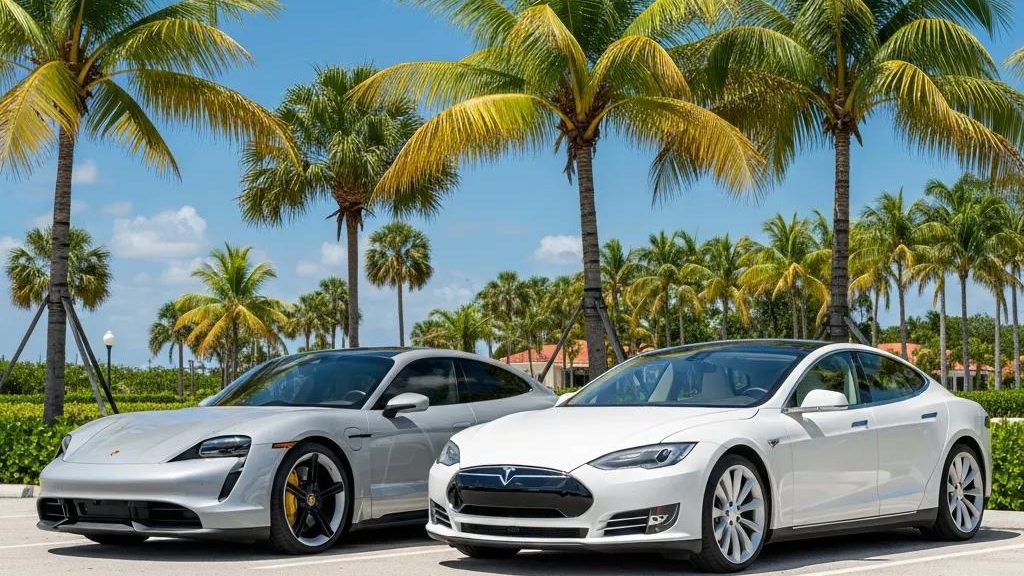
The luxury electric sedan market has matured quickly, and two names keep coming up: the Porsche Taycan and the Tesla Model S. This guide breaks down how they compare across performance, range, interior design, ownership costs, and real-world ownership in South Florida. We’ll highlight each car’s strengths and trade-offs so you can decide which aligns with your priorities — whether that’s driver engagement, long-distance range, or local service and support.
How Do Porsche Taycan and Tesla Model S Compare in Performance and Driving Dynamics?
Performance matters in this segment, and both cars deliver it — but with different philosophies. Porsche tunes the Taycan for a sporty, driver-focused experience; Tesla tunes the Model S for blistering straight-line speed and efficiency. The result is two very capable cars that appeal to different kinds of drivers.
What Are the Acceleration and Speed Differences Between Taycan and Model S?

Both vehicles are extraordinarily quick. The Taycan Turbo S posts a 0–60 mph time of about 2.4 seconds, while the Tesla Model S Plaid is even faster on paper at roughly 1.99 seconds. That raw pace underscores both brands’ engineering strengths: the Taycan leans into a sports-car feel with precise control, while the Model S emphasizes straight-line performance and outright speed. Top speed figures reflect that balance as well — Taycan Turbo S around 162 mph versus Model S Plaid at about 200 mph.
How Do Handling and Ride Comfort Differ Between the Two Luxury EVs?
The Taycan is built to engage: a low center of gravity, tuned suspension, and steering feedback make cornering feel planted and responsive. The Model S prioritizes composure and long-distance comfort, delivering a smooth, relaxed ride that suits daily driving and highway cruising. If you prefer an athletic drive, the Taycan will likely feel more rewarding; if comfort and relaxed pace are your priorities, the Model S will be easier to live with every day.
What Are the Range and Charging Capabilities of Porsche Taycan vs Tesla Model S?
Range and charging strategy are key practical considerations. The two cars take different technical approaches, which affects how they perform on long trips and how quickly you can recharge.
How Does the EPA Estimated Range of Taycan Compare to Model S in Real-World Use?
EPA figures illustrate the gap: the Taycan Turbo S is estimated at roughly 238 miles, while the Tesla Model S Long Range is rated near 405 miles. In everyday driving the Model S generally covers more miles per charge, but the Taycan’s focus on performance can mean a more dynamic — and sometimes more energy-intensive — driving experience.
What Are the Charging Speeds and Infrastructure Differences, Including Taycan’s 800-Volt Architecture?
Charging architecture is a major distinction. Porsche uses an 800‑volt system in the Taycan that supports very fast DC charging — for example, going from about 5% to 80% in roughly 22.5 minutes at compatible high-power stations. Tesla’s Model S uses a ~400‑volt architecture and typically goes from 10% to 80% in about 30 minutes on a V3 Supercharger. Beyond raw speed, Tesla’s Supercharger network remains more widespread, which simplifies long-distance travel for Model S owners. Both approaches have real advantages depending on how and where you drive.The Taycan’s 800V architecture is one of its key technical differentiators and is the focus of recent technical analyses.Porsche Taycan 800V Battery & Powertrain Analysis A focused technical review of the Taycan Performance Battery Plus and its 800‑volt architecture, showing how the higher-voltage system enables faster charging and improved power delivery under demanding conditions. … Art of Electric Powertrains in Battery Electric Vehicles: Comprehensive Analysis of the Two-Speed Transmission and 800 V Technology of the Porsche Taycan, N Rosenberger, 2025
How Do Interior Design, Technology, and Luxury Features Differ Between Taycan and Model S?
Interior design shapes daily enjoyment. Both cabins are high quality, but they express luxury differently: Porsche leans on traditional materials and driver-focused ergonomics, while Tesla emphasizes a modern, minimalist digital experience.
What Sets Porsche Taycan’s Interior Quality Apart from Tesla Model S’s Minimalist Cabin?
The Taycan combines sporty ergonomics with premium materials — leather, metal, and wood or carbon trim — and a layout that prioritizes the driver. The Model S offers a pared-back, tech-forward cabin centered on a large touchscreen that controls most vehicle functions. That minimalism feels contemporary, but some buyers prefer the tactile richness and intentional controls of the Taycan’s interior.As EV interiors evolve, buyers weigh material quality, layout, and how much they want physical controls versus a touchscreen-first experience.EV Interior Design: User Expectations & Luxury Trends A comparative study of EV interiors across price tiers, highlighting user expectations for materials, layout, and the balance between minimalism and tactile luxury in modern electric vehicles. Automotive Interior Design in the Age of Electric Vehicles: User Interface Expectations, Perceptions and Preferences, R Gomez, 2024
How Do Infotainment Systems and Driver-Assist Technologies Compare?

Both cars offer advanced infotainment and driver-assist features. The Taycan uses a multi-screen layout that keeps key information close to the driver, while the Model S relies on a central touchscreen for most controls. Tesla’s Autopilot suite is well-known for its advanced driver-assist capabilities, including lane-keeping and adaptive cruise. Porsche offers a comprehensive driver-assist package as well, but Tesla’s long track record with software-driven features gives it an edge for owners who prioritize continuous tech updates.
What Is the Ownership Experience and Value Proposition of Porsche Taycan Compared to Tesla Model S?
Ownership considerations — price, depreciation, service, and local support — often decide which car makes sense long term. Below we summarize how each model stacks up.
How Do Pricing, Depreciation, and Resale Value Compare Between the Two Models?
Starting pricing is roughly comparable: the Taycan base model begins near $96,300, while the Tesla Model S Long Range is around $89,990 and the Plaid near $109,990. Both cars depreciate, but the Model S has historically kept strong resale value thanks to broad market demand and brand recognition. Consider expected depreciation, incentives, and local demand when estimating total cost of ownership.Looking at market depreciation trends helps give context to long-term ownership costs for luxury EVs.Luxury EV Depreciation & Ownership Cost Analysis A three‑year study of luxury EV resale patterns and ownership costs, highlighting typical depreciation rates and factors that influence second‑hand market sustainability. Depreciation in the electric vehicle transition: Sustainability of the second-hand electric vehicle market, P Gautam, 2024
What Service, Warranty, and Support Does Champion Porsche Offer for Taycan Owners?
Champion Porsche in Pompano Beach provides factory-level service and parts for Taycan owners, with technicians trained specifically on Porsche electric platforms. That local expertise can be an important advantage for buyers who want convenient, brand-expert support and maintenance for their luxury EV.
How Does the South Florida Market Influence the Porsche Taycan vs Tesla Model S Buying Decision?
Local conditions — inventory, charging access, and service availability — matter a lot. South Florida’s seasonal traffic, charging rollout, and dealership presence should factor into any purchase decision.
What Is the Availability of Porsche Taycan Inventory at Champion Porsche in Pompano Beach, FL?
Champion Porsche keeps a rotating inventory of new and pre-owned Taycan models, giving local buyers access to a range of trims and options. Visiting the showroom lets you compare configurations in person and arrange test drives tailored to your driving needs.
How Do Local Charging Infrastructure and Service Options Affect Ownership in South Florida?
Charging options in South Florida have expanded steadily, with more public chargers and Level 2 stations becoming available. That growth benefits both Taycan and Model S owners. For buyers who value nearby, brand-specialist service, Champion Porsche’s presence in the region provides added assurance for maintenance and repairs.
| Model | Acceleration (0-60 mph) | Top Speed | Estimated Range | Charging Speed |
|---|---|---|---|---|
| Porsche Taycan Turbo S | 2.4 seconds | 162 mph | 238 miles | 22.5 minutes (5% to 80%) |
| Tesla Model S Plaid | 1.99 seconds | 200 mph | 405 miles | 30 minutes (10% to 80%) |
The Taycan and Model S represent two thoughtful approaches to luxury EV design: the Taycan prioritizes driver engagement and refined materials, while the Model S prioritizes range, charging convenience, and software-driven features. Your choice will come down to which strengths align with how — and where — you drive.
Frequently Asked Questions
What are the key differences in warranty coverage between the Porsche Taycan and Tesla Model S?
Porsche generally offers a four-year or 50,000-mile limited warranty that covers the vehicle and its electric components. Tesla’s Model S typically includes an eight-year or 150,000-mile warranty for the battery and drive unit, which provides longer coverage for those components. Warranty terms can influence peace of mind and should be reviewed at the time of purchase.
How do the maintenance costs compare for the Taycan and Model S?
Routine maintenance can differ: the Taycan’s specialized parts and Porsche‑level service may result in higher scheduled service costs, while Tesla’s simpler drivetrain design can reduce some routine expenses. That said, both EVs generally require less frequent mechanical service than comparable internal-combustion luxury cars.
What are the environmental impacts of manufacturing the Taycan compared to the Model S?
Both manufacturers emphasize sustainability, but processes vary. Tesla has invested heavily in recycled materials and renewable energy at some production sites. Porsche has its own sustainability initiatives but has faced scrutiny around certain supply-chain aspects, particularly battery sourcing. Buyers concerned about lifecycle footprint should review manufacturer sustainability reports for the most current information.
How do the resale values of the Taycan and Model S compare over time?
Resale values depend on market demand, mileage, condition, and model popularity. Historically, the Model S has shown resilient resale values due to strong consumer demand and brand recognition. The Taycan’s resale trajectory is still evolving as the model gains broader market presence.
What are the differences in software updates and features between the two vehicles?
Tesla is well-known for frequent over‑the‑air updates that add features and refine systems without a dealer visit. Porsche also provides software updates, but Tesla’s cadence and scope of OTA improvements tend to be more aggressive — an important consideration if ongoing software-driven enhancements matter to you.
How do the driving ranges of the Taycan and Model S affect daily usability?
Range directly affects how often you need to charge. The Model S’s roughly 405-mile EPA range makes it better suited to long trips with fewer stops. The Taycan’s roughly 238-mile EPA figure fits well for shorter commutes and spirited driving but may require more planning on extended trips. Your daily mileage and access to chargers should guide the decision.
Conclusion
There’s no single “better” choice — only the right one for your priorities. Choose the Taycan if you value sharp handling, premium materials, and a focused driving experience. Choose the Model S if maximum range, fast-charging convenience, and frequent software updates top your list. If you’re local to South Florida, factor in Champion Porsche’s service capabilities and regional charging coverage when making your decision. Visit us to compare both models side by side and take a test drive to see which car fits your life best. Visit us online here.