The $40,000 Crossroads.
The $40,000 Crossroads: Where Smart Money Makes a Different Turn
You’re standing at the dealership, spreadsheet in hand, comparing monthly payments. Option A: a brand-new mainstream compact SUV with cloth seats and a four-cylinder engine. Option B: a three-year-old luxury SUV with 35,000 miles, leather, a V6, and a badge that signals something. Most buyers take Option A. The savvy ones? They’re asking different questions.
The pre-owned luxury SUV market isn’t about settling. It’s about strategic positioning—and the math has never worked more in the buyer’s favor.
The Depreciation Arbitrage
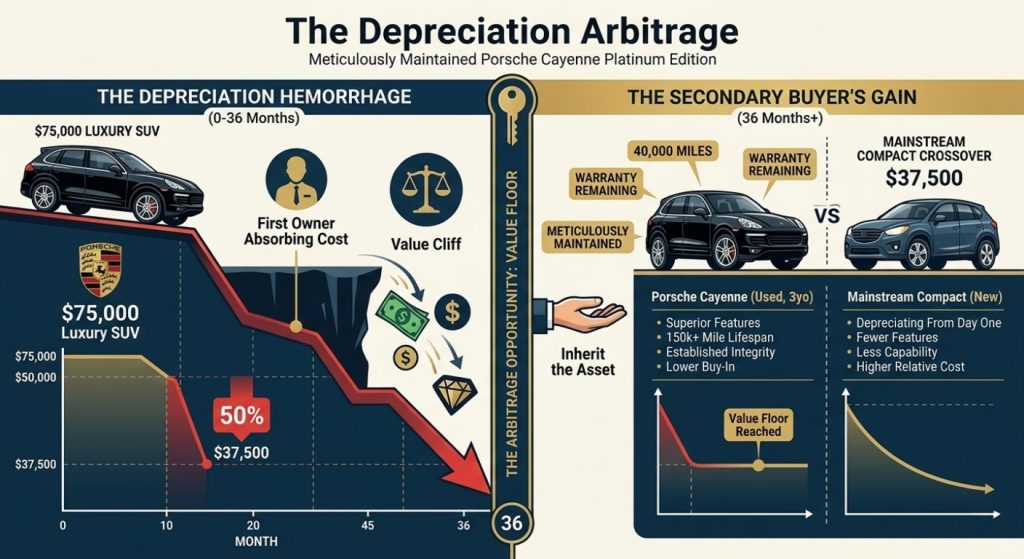
Luxury SUVs don’t just lose value. They hemorrhage it—in ways that create opportunity.
A $75,000 luxury SUV typically sheds 40-50% of its value within 36 months. That means a meticulously maintained, low-mileage example with original warranty coverage remaining often trades hands for less than a new mid-size mainstream crossover. The previous owner absorbed the steepest depreciation curve. You inherit the asset at its value floor.
Consider the Porsche Cayenne Platinum—a model that maintains remarkable structural integrity even as its market price adjusts. These vehicles were engineered with 150,000+ mile lifespans in mind. At 40,000 miles, they’re barely past adolescence.
The mainstream compact? It’s starting its life at the price you’ll pay, depreciating from day one, with fewer features and less capability.
Feature Density: The Hidden Calculation
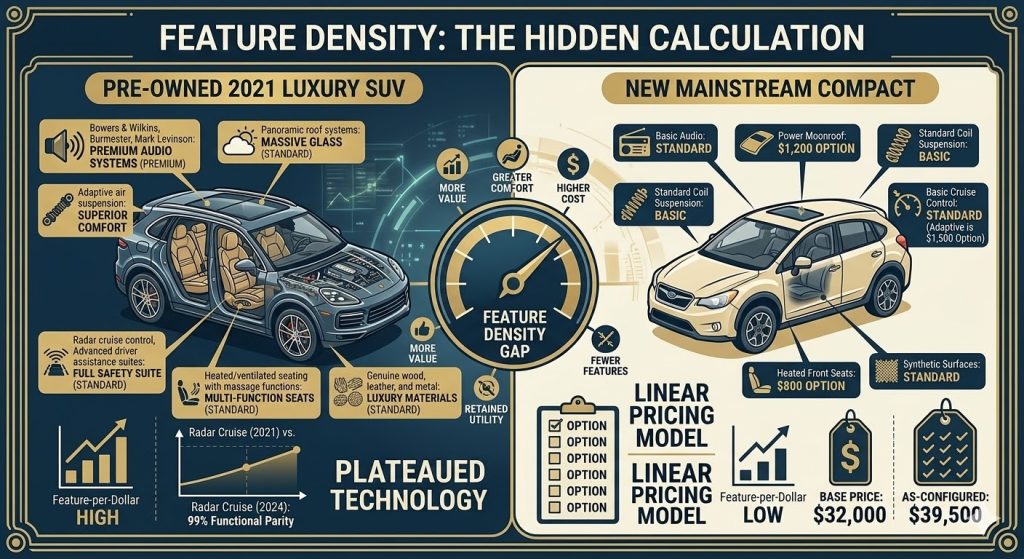
New vehicle pricing follows a linear model: you pay incrementally more for incremental upgrades. Pre-owned luxury follows a different curve entirely.
A 2021 luxury SUV often includes:
- Adaptive air suspension
- Panoramic roof systems
- Premium audio (Bowers & Wilkins, Burmester, Mark Levinson)
- Advanced driver assistance suites
- Heated/ventilated seating with massage functions
- Genuine wood, leather, and metal interior materials
The new compact at similar money? You’re selecting packages, adding line items, and still ending with synthetic surfaces and a smaller footprint.
The feature-per-dollar ratio isn’t close. And unlike technology products where three years means obsolescence, automotive luxury features have plateaued—radar cruise control from 2021 functions essentially identically to 2024 implementations.
The Psychology of Pre-Owned: Reframing the Narrative
Here’s where semantic precision matters. “Used car” triggers associations: someone else’s problems, mystery maintenance, compromise. “Pre-owned vehicle”—particularly certified pre-owned luxury—activates different mental frameworks: curated selection, professional reconditioning, value intelligence.
Modern luxury pre-owned programs have evolved beyond basic inspections. We’re talking:
- 150+ point mechanical examinations
- Cosmetic reconditioning to factory standards
- Extended warranty coverage that exceeds original terms
- 24/7 roadside assistance and concierge services
- Exchange privileges and return windows
The gap between “new” and “pre-owned” has narrowed to the point of irrelevance for many buyers—while the price gap remains substantial.
The SUV Advantage: Practicality Without Penalty
Luxury SUVs specifically offer a unique value proposition in the pre-owned market. Unlike sports cars or sedans, they retain utility relevance across life stages. A pre-owned Cayenne or comparable luxury SUV serves equally well for:
- Daily commuting with fuel-efficient highway manners
- Family transport with legitimate three-row capability
- Towing and outdoor recreation (many handle 7,000+ lbs)
- Professional contexts where arrival matters
The mainstream compact promises flexibility. The pre-owned luxury SUV delivers it without the capability compromises.
Calculating Total Cost of Ownership
Savvy buyers look beyond the monthly payment. They factor:
Insurance: Luxury SUVs often cost marginally more to insure, but the gap narrows with pre-owned status and safety feature density.
Maintenance: Yes, premium vehicles have premium service costs. But with remaining factory warranty, prepaid maintenance plans, and the elimination of early-ownership depreciation, the three-year total cost frequently undercuts the mainstream alternative.
Resale: When you eventually sell, that pre-owned luxury SUV depreciates more slowly from its adjusted baseline. The mainstream vehicle continues its descent from an already-lower starting point.
Financing: Pre-owned luxury often qualifies for competitive rates, particularly CPO inventory. The payment gap versus new mainstream narrows further.
The Test Drive That Changes Minds
There’s a moment in the comparison process that shifts everything. It’s when you close the door of the pre-owned luxury SUV and hear the solidity. When you accelerate onto the highway and feel the engineering margin. When you realize the vehicle was built for 200,000 miles, and you’re buying it at mile 40,000.
The new compact feels capable in isolation. The pre-owned luxury feels inevitable by comparison.
Making the Strategic Choice
This isn’t about brand snobbery or status signaling. It’s about resource allocation. The same buyer who researches investment fees, negotiates mortgage rates, and optimizes tax strategy recognizes an inefficient market when they see one.
Pre-owned luxury SUVs represent that inefficiency—a category where quality and capability exceed price in ways that new mainstream alternatives cannot match.
The question isn’t whether you can afford a new compact. It’s whether you should, knowing what the same resources access in the pre-owned luxury market.
Ready to explore pre-owned luxury SUV inventory? Our selection includes professionally reconditioned models with transparent history, remaining warranty coverage, and pricing that redefines what your budget commands.